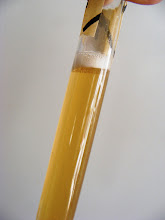
I am happy to report that the nano "Yorkshire Square" performed fabulously for it's inaugural fermentation. I decided to use WLP 0023 "Thames Valley" yeast to inoculate this fermenter with. Being an open fermentation I was looking for a true "top cropping" yeast to provide a good biological cover to the fermenting wort. I also wanted a yeast with lots of character which I thought would be fitting for beer being produced in this fermenter.
Boy, I was not disappointed. This yeast took off quick! The once the krausen started rising I could almost see it rising before my eyes. Certainly there were noticible differences as I checked it every hour. I thought the most interesting point was fairly early on as the krausen really began to take off in what I called the merangue phase. It really looked like a merangue on a pie! It was right around this phase when there was enough anaerobic metabolism going on that the carbon dioxide was able to snuff out a flame.
The fermenter holds 6.5 gallons, apparently I whould have built it bigger (actually that was as big as my materials would allow). Five gallons of wort went into the fermenter and the krausen rose right up to the top and even overflowed a bit!
I've done a lot of fermentations in my house but I've never done one that was quite odiferous as this one. Almost as soon as that fermenation started it was the first smell you noticed when you entered the house. I think being open made a huge difference in terms of the amount of gas and aromas wafting out of the fermenter. I'm really curious to see if there is any noticeable impact on the flavor and aroma of the final product versus a carboy fermented version. We did do a group brew so 20 gallons of wort were produced for 4 different fermentations. Unfortunately I didn't think to have anyone else use the WLP 0023 yeast so we could have a comparison of fermenter effects.
I did have to rack the beer out of the fermenter before it completed it's primary fermentation. The big aroma and foaming over krausen aren't big features people are looking for when you are trying to sell your house and have an open house. It was definitely most of the way through the primary and seemed to finish out just fine in the carboy. Next time I hope to be able to let this ferment out all the way in the square. Actually I'd really like to try doing a mild and send it either straight to the bottle or cask to be drank within just a few weeks of fermentation.
This time around it was a big brown ale with an original gravity of 1.064 and a final gravity of 1.020. Going into the bottle it was tasting pretty good. Can't wait to taste this one once it's carbonated.
Saturday, April 3, 2010
Monday, February 15, 2010
Yay Stirplates and Yorkshire Squares!
Life has been busy for me lately so I haven't had much time to keep up with the blog. We've got a big group brew coming up this weekend so I am building up some starters for people to use. In the process I've inadvertently done a little non-scientific experiment. A couple of my friends would like to brew with Whitbread ale yeast so I made up two 50 ml starters (about 1.040). I grabbed my Whitbread Ale plate and plucked 2 colonies of the plate, one for each starter. One batch went on my stir plate, the other sat on the counter.....48 hours later here are the results:
Notice the starter on the stir plate is nice and cloudy vs the counter top beaker which has a clear wort with only a small colony propagating on the bottom.
After removing the Erlenmeyer flask from the stir plate and allowing the yeast to settle the difference is quite noticeable. Look at the nice layer of yeast cells in the Erlenmeyer vs the small colony in the beaker.
I don't have a microscope at home to do yeast counts but there is visibly more yeast in my starter on the stir plate. I have a second stir plate I built sitting in the basement with a loose connection. I really need to get that one back in operation so I can run multiple stir plates at the same time.
One of the things that has been keeping me busy is brewing gadget product. I've begun to get interested in open fermentation and have been thinking about giving it a try. I've always thought Yorkshire Square ferementers were pretty cool and I decided to build my own mini (or perhaps nano) Yorkshire Square.
There is a large cache of old slate pavers at my parents house that used to make up a walk to their front door (about 20 years ago). These stones have been patiently waiting to be put to good use for quite some time now and conveniently are about the size I needed for this project. So 5 slabs of slate, an inexpensive tile saw purchased on Craig's List, some food grade silicone, and some scrap poplar that was lying around and before you know it I have a new 6.5 gal fermenter.
Weighing in over 50 pounds empty it may not be the most practical piece of brewing equipment but it sure is nice to look at. I have a starter of Burton Ale yeast brewing up to be used in my first batch in the fermenter. Given the number of small cracks and crevices in the stone I assume it will never be sanitized the way a glass carboy can. I am planning to pitch a very large starter to the first batch hoping to innoculate all these small places where microbes might hide. I've picked the Burton Ale yeast for it's flavor profile as well as its reputation as a good top cropper, a trait which seems important in an open fermentation. The wort for this first fermentation will be from a split batch with the other batches being closed. It should be interesting to see what sort of differences (if any) there are between fermenter types.
Notice the starter on the stir plate is nice and cloudy vs the counter top beaker which has a clear wort with only a small colony propagating on the bottom.
After removing the Erlenmeyer flask from the stir plate and allowing the yeast to settle the difference is quite noticeable. Look at the nice layer of yeast cells in the Erlenmeyer vs the small colony in the beaker.
I don't have a microscope at home to do yeast counts but there is visibly more yeast in my starter on the stir plate. I have a second stir plate I built sitting in the basement with a loose connection. I really need to get that one back in operation so I can run multiple stir plates at the same time.
One of the things that has been keeping me busy is brewing gadget product. I've begun to get interested in open fermentation and have been thinking about giving it a try. I've always thought Yorkshire Square ferementers were pretty cool and I decided to build my own mini (or perhaps nano) Yorkshire Square.
Weighing in over 50 pounds empty it may not be the most practical piece of brewing equipment but it sure is nice to look at. I have a starter of Burton Ale yeast brewing up to be used in my first batch in the fermenter. Given the number of small cracks and crevices in the stone I assume it will never be sanitized the way a glass carboy can. I am planning to pitch a very large starter to the first batch hoping to innoculate all these small places where microbes might hide. I've picked the Burton Ale yeast for it's flavor profile as well as its reputation as a good top cropper, a trait which seems important in an open fermentation. The wort for this first fermentation will be from a split batch with the other batches being closed. It should be interesting to see what sort of differences (if any) there are between fermenter types.
Sunday, December 20, 2009
New Lasso Activity, Basic Brewing Radio, and Kombucha!
Life is good at the Ranch! I recently brewed a big American IPA full of Simco and Amarillo hops and lots of late additions which is somewhat out of character for my usual brewing habits. I figured if I was going for a big classic American IPA I should use a classic yeast. So Wyeast 1056 - American Ale into the fermenter and into the ranch. What a great yeast, it ripped through my IPA with an 88% apparent attenuation in less than a week and that was with a pretty bad underpitch on my part. I'm happy to have this one on hand and will probably be brewing with it frequently.
I also lassoed a sample of Wyeast 3068 - Weihstephan Weizen from my friend before he pitched it into a weizen he brewed. I don't brew or drink a lot of wheat beers so it is interesting getting this into the collection. It should prove inspiration for some future brewing.
Speaking of inspiration, check out the December 17th, 2009, episode of Basic Brewing Radio. Yours truly an some of the guys from the SouthCoast Homebrewers Association discuss our big partigyle in an episode James calls Partigyle Gone Wild. We are now referring to the technique of combining second runnings from multiple mash tuns to build a stronger beer as "collaborative mashing" Just about everything is fermented out now but some is waiting to get into the bottle still (I'm currently having a bottle shortage!). Thanks James, we had a blast on the show and plan to do another collaborative mash in the spring. This time we are talking about doing big wheat beers so that Weihstephan Weizen should come in handy!
On a side note from beer. I recently got a Kombucha starter from my friend Scott. I just put my first batch in the fridge tonight. I had never heard of Kombucha until recently but I'm gain to try anything that ferments! My first batch is tasting pretty good. Now I just need to get a ginger beer plant....
Sunday, November 29, 2009
Trappist High Gravity, Sour Mashes, Partigyles.........Beer is way to much fun!
Since the last post I've added the Trappist High Gravity (Wyeast 3787) to the stable. My brewclub got this yeast to use for a Belgian partigyle that we did a couple of weeks ago. The partigyle was an interesting affair that was a adaptation of a standard partigyle (many thanks to Scott for all his hard work on figuring this out). We didn't want a big beer and a small beer, instead we wanted 3 beers of good or strong gravity. We used two separate mash tuns each to produce a strong wort. Then we sparged a second running out of each mash tun with about half the volume we would have for a normal beer. We combined these two second runnings together to create the wort for the third beer. The result was that we created a Quadrupel, Tripel, and Dubel all in one session. For an added bonus we sourmashed our leftover grains for 24 hours and were able to produce two sour beers of reasonable gravity as well! (I added sour cherry juice to mine in the fermenter and it is tasting fantastic so far)
The Trappist High Gravity has done a great job fermenting out the Quadrupel and has handled the multiple "Candi" syrup additions (Listen to the Homade Candi Syrup episode on Basic Brewing Radio to learn how to make this) very well. The beer is a wonderfully malty, complex big beer. It doesn't have as much of the "Belgian" character from the yeast as I was hoping for but I don't have temperature control for my carboys yet and it fermented around 66-68 F which is lower than what I would have liked to ferment it at. Even so it is shaping up to be a great beer.
This evening I created a 50 ml starter and picked off a colony of the Trappist High Gravity to toss in. This should be going into a friend's Patersbier next weekend. Can't wait to see how that comes out.
I'm planning an American IPA next weekend which is a little bit different from what I usually brew so I'm looking forward to that. Lots of Amarillo and Simcoe hops and lots of late additions! I'm picking up a package of Wyeast 1056 which seems like a fitting yeast for this type of IPA. I haven't brewed with this one in years but will be sure to snag a sample to go into the stable so it can work it's way into the rotation.
Pretty soon I'm going to need to make up some more plates and slants!
Thursday, November 5, 2009
I could Cry Havoc all night long!
So that little Cry Havoc starter got built up into a 1 liter starter and went into a 1.084 Imperial Oatmeal Stout. Boy it is nice when you have a good starter. There was obvious fermentation going on within an hour or to of pitching that yeast. Good thing I have a blow-off tube! Too bad the bow-off bucket I used was too small!
Anyway, I've been really happy with the Cry Havoc yeast. I fermented this beer in my basement where the temp has been around 65 or 66 F and it brought this beer down to 1.020 in 3 or 4 days! I was hoping to get the gravity a little lower but my mash ended up being pretty warm and there are a lot of oats in this beer. Regardless this little guy gave me an apparent attenuation of 74% which is pretty good considering it is only rated to 70%.
This coming weekend the SouthCoast Homebrewers Association is planning a Belgian Partigyle. It's a bit of an experiment for the group. This isn't really a traditional partigyle but a sort of hybrid where we are using to mash tuns. One will produce a wort for a Quad, the second will produce a wort for a Tripell, and the second runnings from both systems will be combined to try and make a Dubell.. On paper it works, we'll see what happens once the yeast is pitched.
I'm breaking out my trusty culture of WLP 550 Belgian Ale for one beer and we have a new addition to the stable, Wyeast 3787 Trappist High Gravity. I'm really excited about this one too! We will be using it in two of the beers.
Right now I only have one stir plate so the Trappist yeast is getting a stir and the Belgian Ale is building up old school. Interestingly, I do have a second stirplate stashed away. A couple of years ago I decided to build my own with a computer fan and rare earth magnets. It was a fun project and everything looked great but I was never able to get the stir bar I had at the time to couple well with the magnets and actually stir. Since I got my new stir plate and stir bar I finally figured out what the problem was....the original stir bar that I had was not magnetized! It is just a plastic coated piece of metal. It sticks to the stir plate but even on my new stir plate doesn't make a strong enough magnetic coupling to stir.
Well that stir bar is going straight into the trash (as soon as I fish it out of the bottom of the WLP 550 starter)! I have a new magnetized stirbar on the way. Now I just need to fish out the homemade stirplate, re-solder some of the connections that have become broken as I have fiddled with it, and I will be all set to have 2 starters stirring concurrently! YeeeHaaawww!
Anyway, I've been really happy with the Cry Havoc yeast. I fermented this beer in my basement where the temp has been around 65 or 66 F and it brought this beer down to 1.020 in 3 or 4 days! I was hoping to get the gravity a little lower but my mash ended up being pretty warm and there are a lot of oats in this beer. Regardless this little guy gave me an apparent attenuation of 74% which is pretty good considering it is only rated to 70%.
This coming weekend the SouthCoast Homebrewers Association is planning a Belgian Partigyle. It's a bit of an experiment for the group. This isn't really a traditional partigyle but a sort of hybrid where we are using to mash tuns. One will produce a wort for a Quad, the second will produce a wort for a Tripell, and the second runnings from both systems will be combined to try and make a Dubell.. On paper it works, we'll see what happens once the yeast is pitched.
I'm breaking out my trusty culture of WLP 550 Belgian Ale for one beer and we have a new addition to the stable, Wyeast 3787 Trappist High Gravity. I'm really excited about this one too! We will be using it in two of the beers.
Well that stir bar is going straight into the trash (as soon as I fish it out of the bottom of the WLP 550 starter)! I have a new magnetized stirbar on the way. Now I just need to fish out the homemade stirplate, re-solder some of the connections that have become broken as I have fiddled with it, and I will be all set to have 2 starters stirring concurrently! YeeeHaaawww!
Tuesday, October 20, 2009
Go Little Guy Go!
As I mentioned with my latest starter I decided to pluck a colony and through it into 35-40 mls of wort vs the 10-15 mls that I have been doing. I was a little worried that that little colony would have trouble inoculating that volume of wort. I am happy to report that that little Cry Havoc yeast had no problem showing that wort sample who is boss!
This postings pic is my little 50 ml ehrlymer with the Cry Havoc starter fermenting away on my stir plate. Hopefully tonight I'm going to kick it up to 400-500 mls and in a few more days see if I can push more towards 2 liters.
I've got a big stout coming soon with an estimated OG of around 1.090 so I want to make sure that I've got lots of yeasties to handle it.
Friday, October 16, 2009
Happy Fermentations!
Everything is going well on the old yeast ranch. The Eastcoast ale starter did a great job fermenting out the "Redheaded Stepchild". There was evident fermentation within 2-3 hours of pitching the yeast!
All the strains were successfully replated with no contamination picked up. It is great to see those colonies looking happy and healthy again. They were starting to look pretty sorry on the old plates. In addition I put several strains onto slants. This is the first time I've done slants and I really like them. They take up a lot less space in the fridge, are much less likely to pick-up contamination, and are less likely to break than my glass plates. I don't have enough tubes to transfer my all the cultures over to slants yet but I will be getting more at some point.
I'm planning a big imperial oatmeal stout next weekend so I'm getting another starter going. This time around instead of starting with 10-15 mls I am starting with 45 mls of 12 brix wort. Hopefully that is not to much volume for that little colony to handle, I guess I'll find out. My goal is to create a larger starter than I usually do. Usually I have a 700-800 ml starter. This is basically because I have a 1000 ml ehrlymer flask that I usually do my starters in. I think many people would argue that 700-800 mls is underpitching. This might be true, right now I'm not set up to do yeast counts. I do know that the starters I've been using have been taking right off and fermenting my worts out well. Usually I am doing session beers with a gravity in the 1.035-1.045 range, this time around I'm aiming for 1.085-1.090 and I might need some more yeast cells than my typical beer! I am going to step this starter up into an old growler. That should let me get my volume and yeast count up.
Oh, in case you are wondering I'm stepping up Cry Havoc of one of the plates. I really like this yeast and it should be able to handle the slightly cold temps in my basement right now. Thanks Charlie Papazian!
Subscribe to:
Posts (Atom)